スループット
Higher is better0.00M objects / hr
+15K vs. Load Balancer
MetaDefender™ Cluster1,928,000
Load Balancer1,913,000
ベニー・チャーニーの著書『Cybersecurity Upside Down』の詳細はこちら
MetaDefender™ Cluster distributes scanning across multiple MetaDefender™ Core instances, sustaining high throughput on archive-heavy workloads where a load balancer alone (which simply spreads incoming requests evenly across servers, without accounting for scan complexity) falls behind.
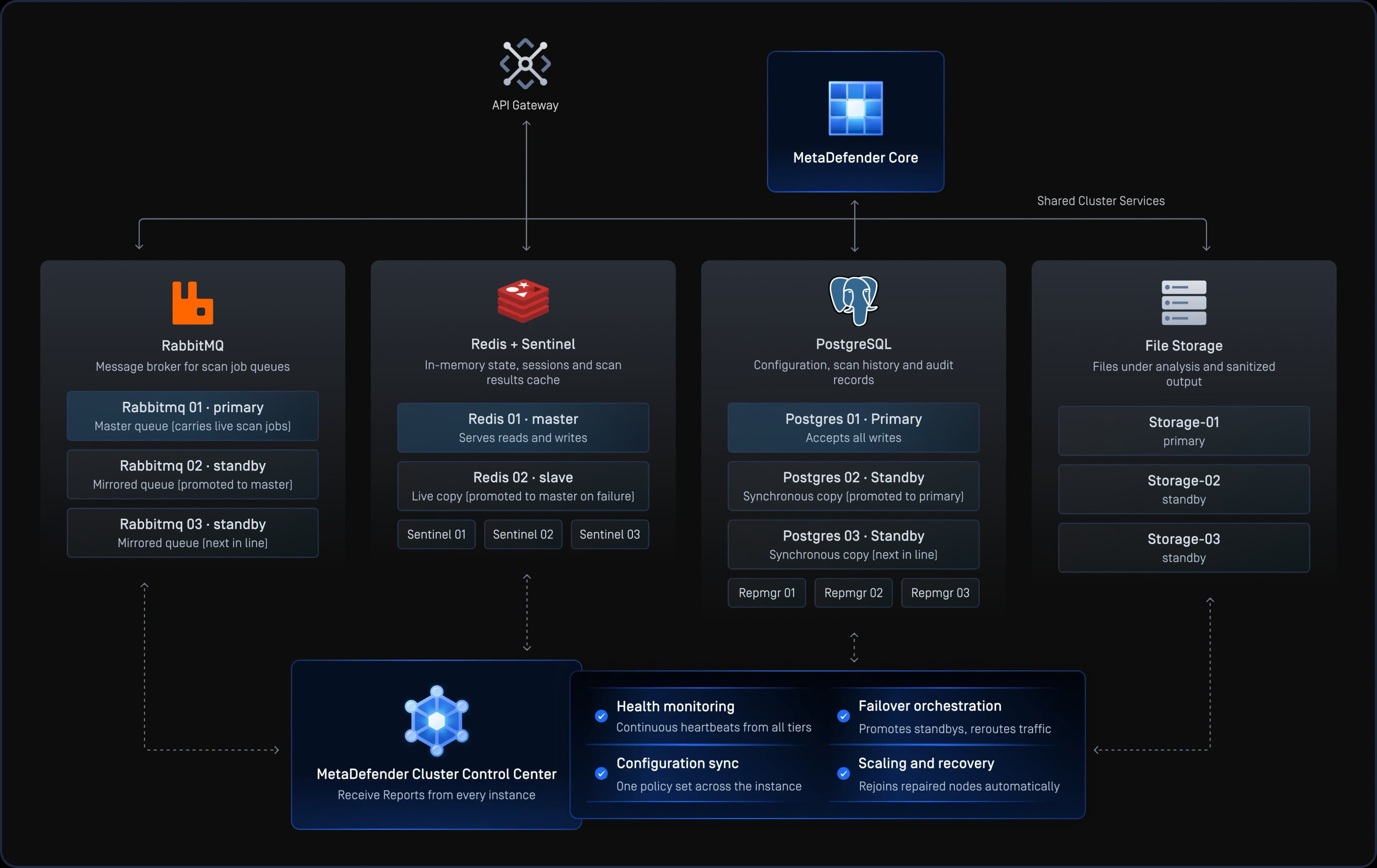
MetaDefender Cluster is built for high-volume, archive-heavy file processing that has to stay fast and available. It spreads work intelligently across MetaDefender Core instances, so throughput scales with demand and no single failure stops scanning.
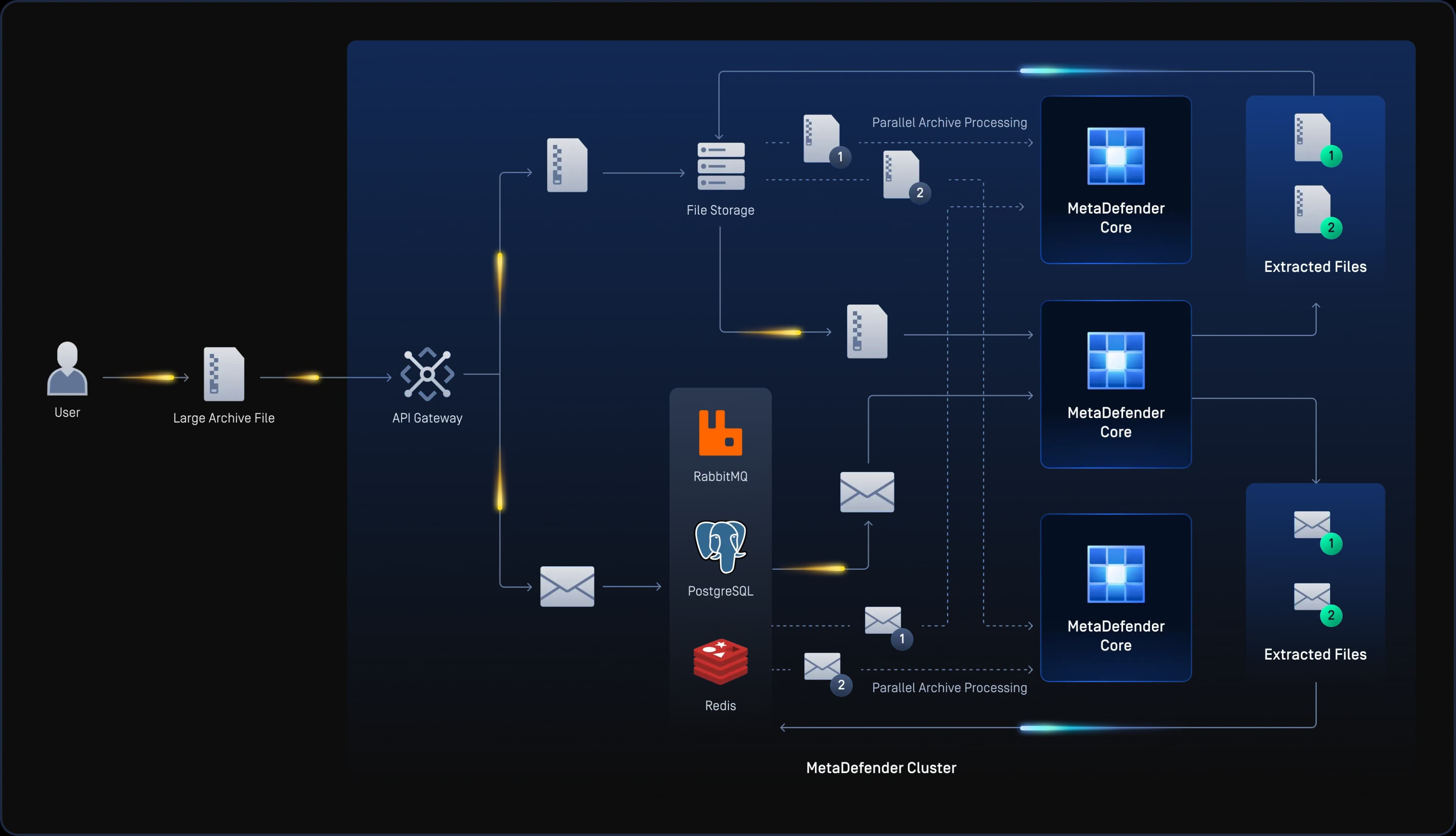
Break the archives and distribute across multiple MetaDefender Core instances, so deep, large files are extracted and scanned in parallel instead of one at a time.
Add MetaDefender Core instances to grow capacity on demand, keeping processing rates steady as file volumes and archive sizes climb.
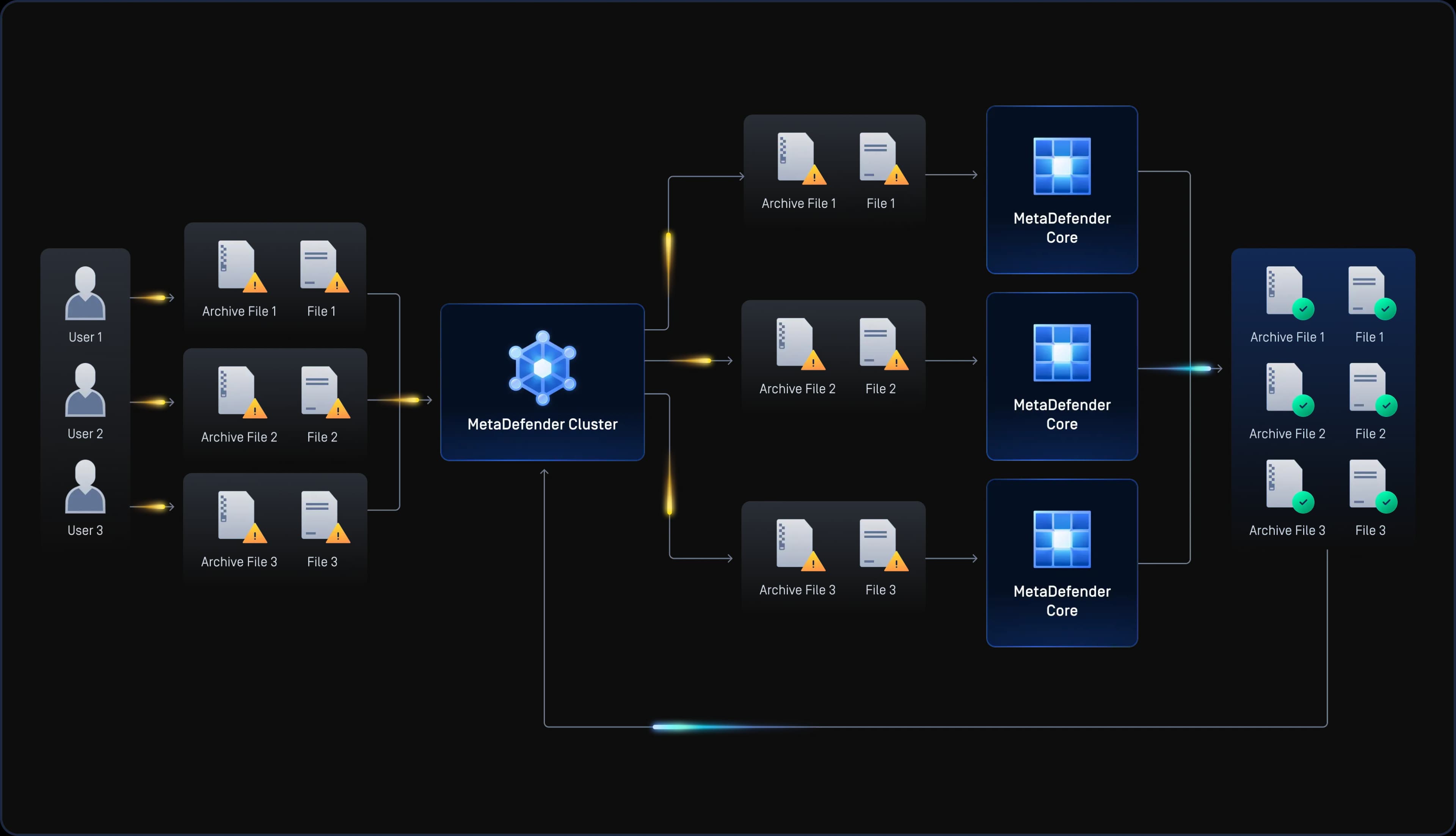
Balances incoming files across all healthy MetaDefender Core instances, so every engine stays busy and work never backs up behind an idle instance.
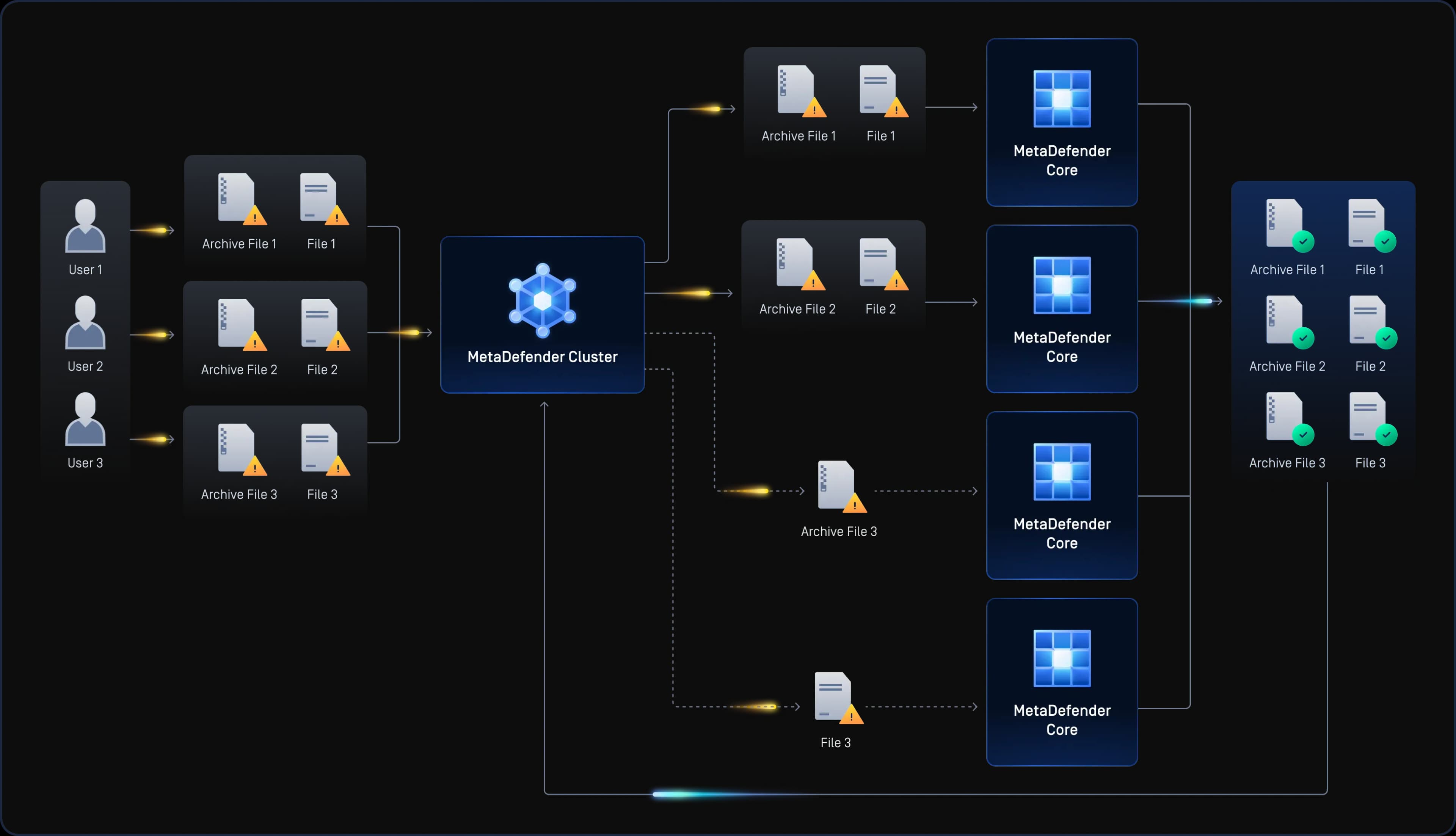
Reroutes work around any MetaDefender Core instance that goes offline, so an individual failure reduces capacity rather than halting scanning.
Break the archives and distribute across multiple MetaDefender Core instances, so deep, large files are extracted and scanned in parallel instead of one at a time.
Add MetaDefender Core instances to grow capacity on demand, keeping processing rates steady as file volumes and archive sizes climb.
Balances incoming files across all healthy MetaDefender Core instances, so every engine stays busy and work never backs up behind an idle instance.
Reroutes work around any MetaDefender Core instance that goes offline, so an individual failure reduces capacity rather than halting scanning.
Drawn from benchmark testing across workloads ranging from single documents to large, nested archives, these numbers show how MetaDefender Cluster sustains throughput, scales as you add MetaDefender Core instances, and keeps every engine working at high utilization.
Than a Load Balancer
Across Every MetaDefender Core Instance
Than a Load Balancer
MetaDefender Cluster brings multiple MetaDefender Core instances together into one elastic scanning pool, so throughput and resilience grow together as you add capacity.
Keeps every core busy, so processing rates hold up under bursty, archive-heavy traffic where a load balancer leaves capacity stranded.
Splits the nested contents of a single large archive across multiple MetaDefender Core instances instead of pinning it to one, the key to the largest speed-ups.
Add MetaDefender Core instances to add capacity. Throughput rises and processing time drops in a way you can size and budget against.
Reroutes work around any MetaDefender Core instance that goes offline, so an individual failure reduces capacity rather than halting scanning.
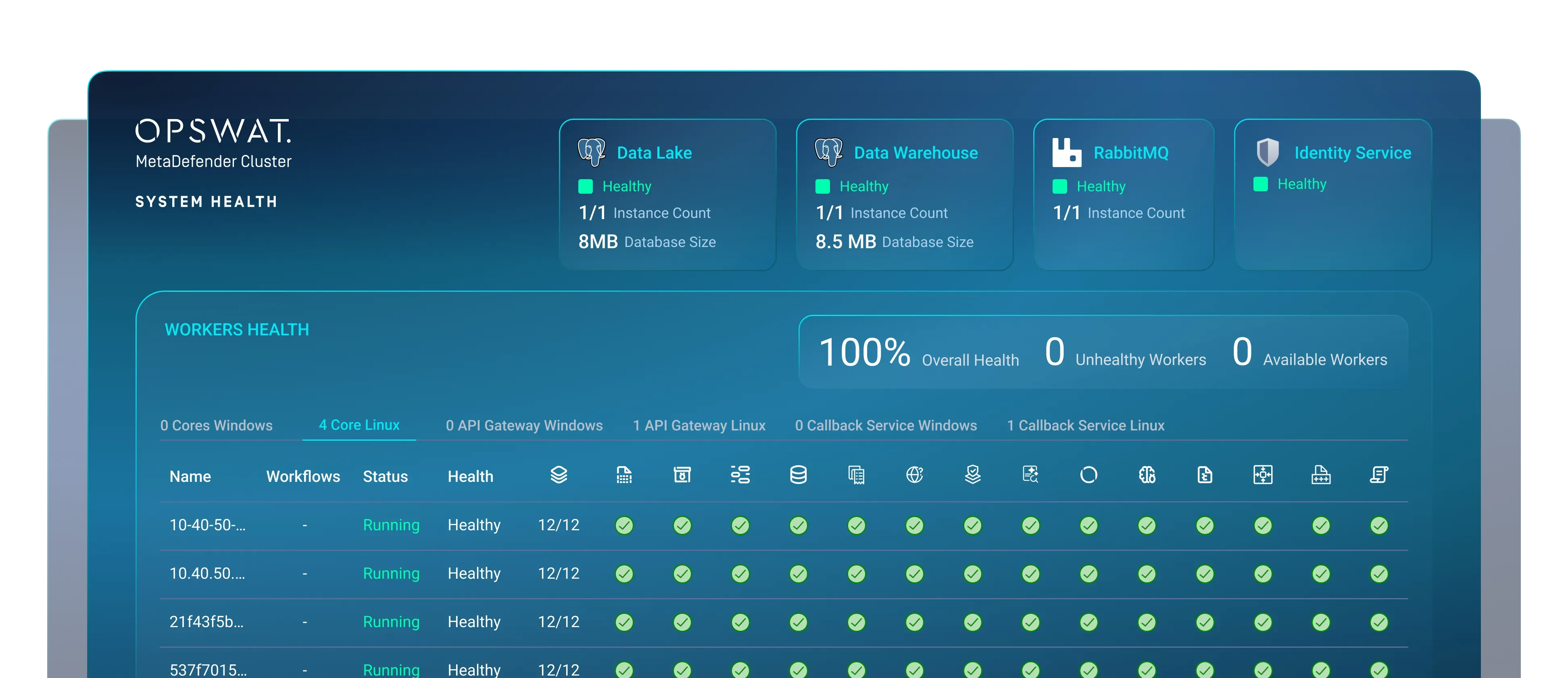
Configure workflows, monitor engine health, and view results for the whole cluster from one console instead of managing each node by hand.
See how a MetaDefender Cluster deployment compares to a load balancer. Three datasets, ranging from single documents to large, nested archives, are run through each setup to measure throughput, duration, and resource use. Learn more about testing environment setting via MetaDefender Cluster Documentation.
Aggressively submitted 2,000,000 non-archive files at a rate of 800 files per second. With no archives to distribute, both deployments perform nearly the same.
Submitted 400 medium archive files (RPM, CAB, EXE) at a rate of 1 file per second. Distributing nested files lets MetaDefender™ Cluster pull clearly ahead.
Submitted large CAB files (5.1 GB compressed, 217 GB extracted) with load sharing enabled. This is where archive distribution matters most.
Run the same datasets through a MetaDefender Cluster to see how throughput rises and processing time drops as you scale the number of MetaDefender Core instances.
2,000,000 files submitted at 800 files per second. Adding cores nearly triples throughput and cuts the run time to roughly a third.
12 MetaDefender Core | 4 MetaDefender Core | |
|---|---|---|
Processed Objects / Hour | 2,850,000 | 1,000,000 |
Total Duration | 42 Min | 120 Min |
400 files submitted at 1 file per second. Nested files spread across more cores, so the throughput gap widens sharply.
12 MetaDefender Core | 4 MetaDefender Core | |
|---|---|---|
Processed Objects / Hour | 4,900,000 | 1,050,000 |
Total Duration | 30 Min | 115 Min |
4 files with archive load-sharing enabled. Splitting a single large archive across MetaDefender Core instances is exactly what MetaDefender Cluster is built for.
12 MetaDefender Core | 4 MetaDefender Core | |
|---|---|---|
Processed Objects / Hour | 4,000,000 | 1,200,000 |
Total Duration | 52 Min | 180 Min |
On large archive workloads, roughly 2x faster. In benchmark testing, MetaDefender Cluster processed a large CAB dataset at 2,120,000 objects per hour in 175 minutes, compared to 1,050,000 objects per hour in 353 minutes for a load-balanced deployment — about half the processing time. The advantage comes from distributing archive contents, so on non-archive files the two perform nearly the same.
Archive load sharing splits the nested contents of a single archive across multiple MetaDefender Core™ instances, so one large archive is extracted and scanned in parallel instead of being pinned to a single instance. It is the mechanism behind the largest measured speed gains — a load balancer routes each file whole to one instance, leaving the rest of the pool idle.
Throughput rises and processing time drops close to linearly. In benchmark testing on a non-archive dataset, scaling from 4 to 12 MetaDefender Core instances raised throughput from 1,000,000 to 2,850,000 objects per hour and cut the run from 120 minutes to 42 — roughly 2.9x the throughput in about a third of the time. Archive-heavy workloads gain more.
It depends on your file volume, the share of archives in your traffic, and your throughput target. Because archive contents are distributed across instances, archive-heavy workloads benefit from more instances than document-only workloads at the same file count. Share your volumes, archive mix, and throughput targets with OPSWAT for a load estimate sized to your workload.
In benchmark testing, MetaDefender Cluster sustained roughly 1.9 to 2.1 million processed objects per hour in the load-balancer comparison scenarios, and up to 4,000,000 objects per hour on a large-archive workload scaled to 12 MetaDefender Core instances. Actual throughput depends on file mix, archive depth, the number of instances, and the engines enabled.
Only marginally. In benchmark testing on 2,000,000 non-archive files, MetaDefender Cluster processed 1,928,000 objects per hour versus 1,913,000 for a load-balanced deployment — a difference under one percent, because there are no archive contents to distribute. MetaDefender Cluster's advantage appears on archive-heavy workloads and when scaling instance count.
MetaDefender Cluster reroutes that instance's workload to the remaining healthy instances, so an individual failure reduces available capacity rather than halting scanning. Incoming files are balanced across all healthy MetaDefender Core instances continuously, so work never queues behind an instance that is offline or idle.